Skip to content

CLINICAL RESEARCH & MEDICAL STANDARDS

The Science Behind Whole-Body EMS: Strength Training, Evidence & Safety.

Supervised whole-body EMS is studied for strength and muscle health, with published research and expert safety recommendations guiding its use.

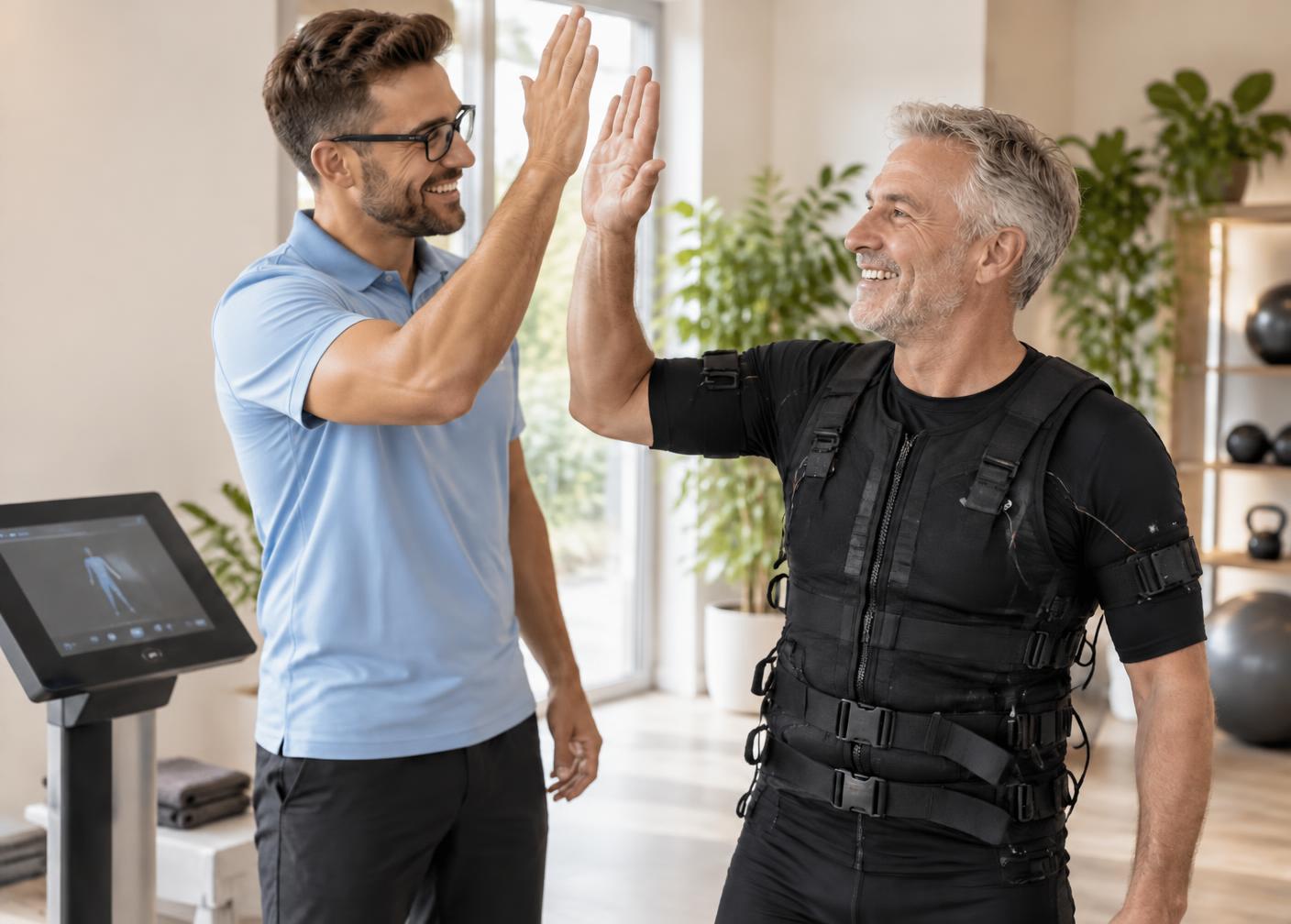
Illustration of a trainer supervising a client wearing a whole-body EMS suit

Whole-body Electrical Muscle Stimulation (WB-EMS) is a training technology studied in both exercise and clinical settings. Understanding what it does—and what the research cannot promise—is part of making an informed choice.

Below, we explain the physiology in plain English, link directly to published studies and set out the screening and supervision that responsible training requires.

The physiology in plain English

How whole-body EMS works

01

An electrical signal. A muscular response.

Controlled electrical impulses delivered through electrodes in the training suit stimulate motor nerves, causing muscles to contract. Your trainer guides simple movements alongside the stimulation and adjusts the intensity to your comfort and ability.

02

Major muscle groups, working together.

Whole-body EMS stimulates several major muscle groups at the same time, with intensity adjusted for each region. This simultaneous stimulation makes it possible to deliver a focused full-body workout without moving between different gym machines.

03

A focus on the trunk and core.

Electrodes over the trunk can stimulate muscles involved in core strength and posture. Conventional strength training can also engage these muscles; EMS offers a different way to apply a muscular stimulus, rather than access to muscles that ordinary exercise cannot reach.

04

Without heavy external weights.

The stimulation provides a muscular challenge without requiring heavy weights on your shoulders or spine. This does not mean zero joint strain or zero risk: movements, intensity and suitability still need to be assessed for each person.

Different lives. Individual suitability.

Who might consider whole-body EMS?

Strength for a busy life

A private session with up to 20 minutes of active stimulation can make strength training easier to fit into a full week. Your trainer adapts the workload and progression; the right frequency and results are individual, not guaranteed by a single weekly session.

Strength for the years ahead

Research in older adults, including people aged 60 and over, has explored strength and muscle health in the context of age-related muscle loss, known as sarcopenia. Movements can be adapted to ability, but improved balance, independence or reversal of muscle loss cannot be promised. Suitability is always assessed before training.

Returning after injury or with joint concerns

If joint concerns or back pain have made exercise difficult, you can explore whether individually adapted strength training is suitable for you. Research has investigated WB-EMS in selected people with chronic low-back pain, but studio training is not treatment or rehabilitation. Medical advice or clearance may be needed.

Read the research

Peer-reviewed clinical evidence

Four publications, with findings and limitations side by side. The original papers provide the full methods, populations and context.

2023

International expert recommendations

International Safety Guidelines for WB-EMS Training

Frontiers in Physiology

The recommendations emphasise qualified trainers, close supervision, health screening, gradual introduction, hydration and adequate recovery between sessions.

In context

These are expert recommendations for non-medical training, not a guarantee of safety. Serious muscle injury, including rhabdomyolysis, has been reported after excessive stimulation, particularly in beginners.

Read the study
2021

Systematic review & meta-analysis

Efficacy of WB-EMS on Strength & Body Composition

Frontiers in Physiology

Across 16 controlled studies representing 897 participants, the analysis found significant improvements in muscle mass and maximum leg and trunk extension strength in non-athletic populations.

In context

Participants, training frequency and study duration varied. Muscle-mass findings showed substantial variation between studies; group-level results do not guarantee an individual's outcome.

Read the study
2017

Individual-patient-data meta-analysis

Effects of WB-EMS on Chronic Low Back Pain

Evidence-Based Complementary and Alternative Medicine

The analysis pooled 45 participants aged 60 and over with chronic low-back pain from five trials. Pain intensity and frequency improved in the WB-EMS group compared with controls.

In context

This was a small, selected population, and the authors called for further targeted trials. It does not establish a deep-spinal-muscle mechanism or show that EMS treats every cause of back pain.

Read the study
2024

Evidence-based German consensus

Evidence-Based Consensus on Medical Contraindications

Frontiers in Sports and Active Living

The consensus revisited contraindications for non-medical WB-EMS. Some conditions were moved to relative contraindications requiring medical assessment; arterial circulation disorders and neurological disorders, including epilepsy, remained absolute exclusions.

In context

These recommendations reflect the German non-medical training context. They are not universal medical clearance, and the authors advise caution before applying them in other settings.

Read the study

Medical transparency

Safety comes before stimulation.

WB-EMS is not suitable for everyone. Screening, supervision and careful progression are essential; even well-supervised exercise is not risk-free.

Important exclusions

These are examples of absolute contraindications for non-medical studio training, not a complete screening checklist.

  • Cardiac pacemakers, defibrillators and other electrical implants
  • Pregnancy
  • Epilepsy or seizure disorders
  • Acute thrombosis or arterial circulatory disorders
  • Acute fever, infections or inflammatory illness

Other conditions may require written medical clearance. A trainer cannot override an absolute exclusion, and medical EMS is not interchangeable with non-medical studio training.

Our safety commitment

  • Private, 1-on-1 certified trainer supervision throughout
  • A thorough health intake before your first session
  • Gentle introduction and gradual individual calibration
  • Ongoing communication about comfort and intensity
  • Guidance on hydration and recovery between sessions

Tell us about health concerns, medication and changes in your circumstances before training. Where necessary, we will ask you to consult your doctor before proceeding.

This page summarises published research for general information. It is not medical advice, a diagnosis or a promise of results. Individual experiences vary.

Ready to Experience the Science for Yourself?

Your first appointment at CURRENT STUDIOS lasts 45 minutes, including an introduction to EMS and a conversation about your goals, suit fitting, gentle calibration and a guided trial workout.